

Queens Birthday Honours for dance
Congratulations to Ausdance founding member Professor Shirley McKechnie AO and Head of Dance at WAAPA and former Chair of the Tertiary Dance Council of Australia, Nanette Hassall AM for their Queen's Birthday Honours.
Both Shirley and Nan have been recipients of an Australian Dance Award for Lifetime Achievement.
Congratulations also to Sydney Dance Company collaborator Iva Davies, and former Chair Rowan Ross.
Renie Allison-Matini of Victoria and Daryl Powell of the ACT were recognised with OAMs for their contributions to the broad dance community.
Tanzkongress 2013 performance highlights
What would an international dance conference be if it did not include an array of performances? Even though Tanzkongress itself was only three days, there were a significant range of performance, workshop and class opportunities.
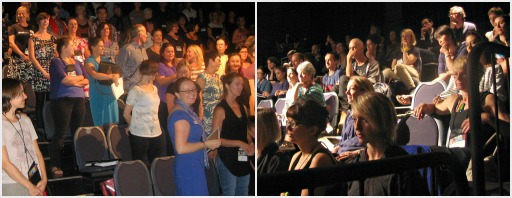
The opening celebrations included the staging of a movement choir entitled Tanz Aller (everyone dancing). Audience members became the performers, directed through individual radio sets with the staging led by the artists' collective Ligna. Movement choirs were popular in 1920s Germany and used at rallies of the working class. The experience was a rich one, a great opportunity to bond with strangers from around the world as we formed patterns and movements, while also hearing the history of the movement choirs.
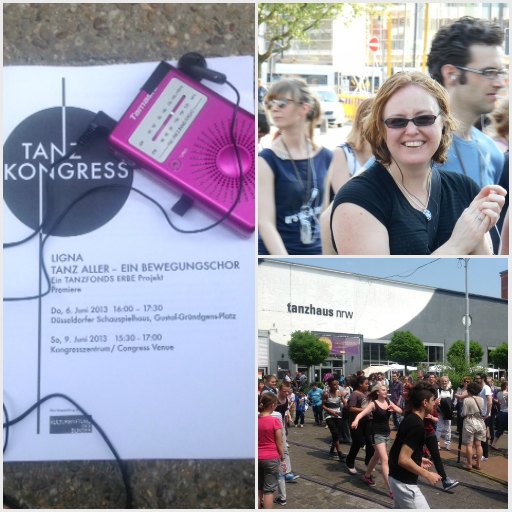 Left: Radio sets were used to direct audience performers in the Tanz Aller movement choir. Right: Audience members performing in the Tanz Aller movement choir (photo Julie Dyson). Below right: Songlines Flash Mob
The main stage opening was a performance of La Creation du monde 1923 – 2012. This performance included a re-staging of the original la creation du monde; a so-called 'ballet negre' originally presented in 1923, book-ended by modern interpretations and questions on the themes presented in the ballet. Colonialism and the appropriations of African cultures were passionately explored by Congolese choreographer Faustin Linyekula and CCN-Ballet de Lorraine.
Other highlights on the program included a 20th Anniversary presentation by Candoco Dance Company. From London UK, Candoco was formed to provide an artistic vehicle for performers with and without disability. They have gathered a strong international reputation including a starring role in the ceremonies of the London Olympics. Chunky Move artistic director Anouk van Dijk teamed up with longer term collaborator Falk Richter for Rausch (intoxication). Seven dancers and five actors explored themes of freedom and connection in spell-binding mix of high-powered theatre and dance.
Of course there were also less formal performances. Dutch choreographer Erik Kaiel has been working with students from St Benedikt school in Duesseldorf, resulting in some flash mob performances in amongst the Congress participants.
Tanzkongress encouraged participation in the creation of new works, as well as the re-staging of the old, through its dance and workshop program. It was a valuable opportunity to see a range of performances from outside Australia.
Tanzkongress 2013—Performing Translations
In 2006 Berlin staged the first Tanzkongress of modern times. Now in its third iteration, the conference has established itself as a vital part of European dance discussions. Supported by the German Federal Cultural Foundation, Tanzkongress draws participants from around the globe including New Zealand, USA, Australia, India and throughout Europe. Tanzkongress 2013 has the theme of 'performing translations' exploring commonalities and differences in dance and how we can work across communication forms.
Translation takes place not only between practices and competences, art forms and styles, ideologies and generations. Art meets politics, practice meets theory, dance meets technology. Tanzkongress program
Around 1000 participants worked with nearly 200 presenters—dancers, choreographers, academics and teachers, producers, and critics—covering areas such as choreography, education, journalism, dramaturgy, politics, architecture, sociology, philosophy, and medicine.
The Dance Congress is a congress for dance, yet one that treats the concept of dance in an extremely broad sense and thus proves the art form's relevance to other disciplines and the connectivity of its discourse beyond dance. Tanzkongress program
On Mentoring
It was impossible to be everywhere and be part of everything, but highlights for me included the ‘On Mentoring’ discussion led by renowned choreographer Jonathan Burrows.
Jonathan presented his thoughts on the idea of mentoring, noting that any application for arts funding in the UK these days needs to include a mentoring component. The audience then broke into smaller groups to reflect and share experiences. Important in an international forum was the cultural implications of mentoring—in that some places only respect direct teacher-student relations rather than the cross-beneficial concepts understood in mentoring. There was also shared recognition that while mentoring can happen in quite fluid ways, there is benefit in formal mentoring relationships that bring with them time, commitment and patience.
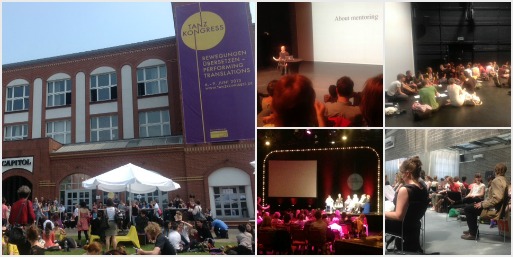 Left: Tanzkongress venue. Top: ‘On mentoring’ discussion led by renowned choreographer Jonathan Burrows. Bottom: Dance for cities panel and audience for ‘East-Western perspectives on dance journalism’. Photos: Roslyn Dundas.
East-Western Perspectives on Dance Journalism
A panel discussion titled 'The Contemporary and the Critical—East-Western Perspectives on Dance Journalism', explored the cultural understandings of dance performance and review. Session participants were witness to an interesting discussion on the need, or not, to have a cultural understanding on a dance piece being witnessed. Traditional and contemporary as dance forms were dissected, as was the overlap of ritual and entertainment. Indian based choreographer Anusha Lall commented "If I have been moved, shifted in my skin" then that moment of empathy is valuable, even if the cultural background or understanding isn't there.
The Renaissance of Dance Cities
Bureaucrats, ballet directors and former politicians gathered for a fiery debate about the place of dance within a city's development. The recognition that people of all walks of life enjoy living in a culturally rich community has supported the development of dance and arts hubs; however, recent economic pressures have seen programs across Europe rolled back. It is clear having infrastructure developed while economic times are good can help maintain connection and development in leaner times; however the priority needs to be supported across all levels of bureaucracy and government.
And outside the lectures and panel discussions...
Tanzkongress participants were able to take dance classes, be part of research, see performances and catch-up with colleagues from around the globe. The German Federal Cultural Foundation have indicated their commitment to Tanzkongress continuing, but in the meantime outcomes from the 2013 conference continue to be added to the Tanzkongress website.
Dance and science—knowledge and creativity.
There is so much we still have to learn about dance. Human bodies have been dancing for centuries and some of our training techniques have been passed on from generation to generation.
At Trinity Laban Conservatoire of Music and Dance, Dr Emma Redding, head of dance science, is leading a growing group of researchers and students applying scientific methods to the dance training we do every day, seeking to gain knowledge about the body and the impact of dance.
Visiting Harlequin HQ
One of the key supporters of the Australian Dance Awards is Harlequin Dance Floors. Established in 1979, Harlequin supply dance floors around the world, so it was great to meet with them at the Harlequin HQ in Kent, England.
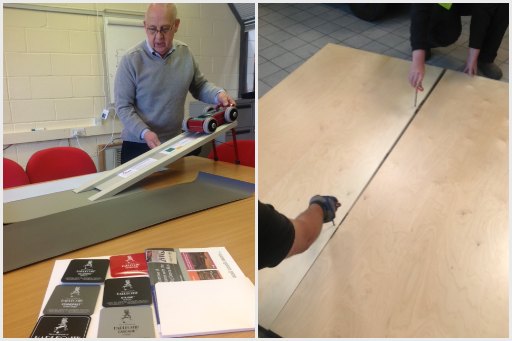 Ray, Technical Director with Harlequin undertaking a slip test on Harlequin vinyl floors. Paul, demonstrating the innovative locking method of the 'Liberty' panels
Mark Rasmussen, Global Group Marketing Manager, took the time to show me the main workshop and a presentation on how Harlequin are continually refining their knowledge and processes with the aim of ensuring dancers get the best support they can from a Harlequin dance floor. Harlequin supply a range of different floor types including portable and permanent floors. They have recently redone the stages at the Bolshi Ballet in Russia, and supply the floors for Sydney Dance Company and the Australian Ballet. Riverdance performances for the last ten years have been on a portable Harlequin floor.
Harlequin have been interested in research (being undertaken in the Netherlands, the United Kingdom and in Australia) looking at the scientific benefits and different impacts of floors on the dancers body. A lot has changed in the last few decades as dancers, teachers and choreographers have become more aware of safe dance practices. A good floor is just as vital to a dancer's wellbeing as a good diet and well-trained technique. Ten years ago research was based on sports floor models, but now we know what a basketballer is looking for out of a floor is significantly different to what a contemporary, classical or ballroom dancer needs. We have known for years that sports floors aren't ideal but research is still underway looking at what is right for dancers. And, of course one of the ongoing challenges is that what a classical dancer requires in a floor is different to what a hip-hop or tap dancer needs. While Harlequin have a growing range of floors available, studio owners, community dancers, performance facility directors and companies need to make an individual assessment about what will work best for their dancers.
Over the coming months DanceUK and Ausdance will be reviewing the recent research on dance floors and updating our dance floor information sheets.
Libby Christie to join The Australian Ballet
Australian arts administrator Libby Christie has been announced as The Australian Ballet’s new Executive Director. Libby will commence the position in late July.
Libby has been acting CEO of the Australia Council since 1 January 2013, with Tony Grybowski recently appointed to take on that role. Ausdance thanks Libby for her leadership and dedication at the Australia Council, leading the Australia Council as the National Cultural Policy was launched, and the review of the Australia Council considered.
The Australian Ballet has issued a media statement with comments from Artistic Director David McAllister and Libby.
“I’m delighted to be working with Libby on realising the company’s vision. She’s a well-respected leader who values collaboration and understands the unique challenges of leading a high-profile and complex arts organisation. I look forward to partnering with her as we enter our next exciting chapter,” said Artistic Director David McAllister.
“I’ve long admired The Australian Ballet for its artistic integrity, progressive approach and strong business achievements behind the curtain. They are one of the world’s busiest ballet companies and lead the way in best practice across many areas,” said Libby Christie.
“I welcome the opportunity to work alongside David, the Board, talented dancers and resourceful administration staff who make up this wonderful organisation. I hope to encourage artistic risks, foster entrepreneurial thinking, promote digital and technological innovation and above all, deliver beautiful performances for a loyal and ever-growing ballet audience.”
Libby takes over from Valerie Wilder, who announced her depature at the completion of her five year contract in October last year. Valerie joined the company in June 2008 from the Boston Ballet and previously from the National Ballet of Canada.
New CEO for Australia Council announced
Minister for Arts, the Hon. Tony Burke MP has announced Tony Grybowski will be the new CEO of the Australia Council, effective immediately.
Chair of the Australia Council, Rupert Myer has welcomed the announcement
“The members of the Council, our staff and members of artistic communities across Australia join me in expressing our delight that Tony has been appointed CEO.
Tony has been Executive Director, Arts Organisations at the Australia Council for the past five years and is well known to artists and arts organisations for his passion and commitment to creativity."
Ausdance National welcomes Tony to his new position, and is looking forward to working with him and the Council over the coming years. Libby Christie, who has been acting CEO since 1 January is thanked for her contribution, leading the Australia Council as the National Cultural Policy was launched, and the review of the Australia Council considered.
Arising from the Australia Council review, the framework legislation for the Council is currently before the Federal Parliament. Ausdance and other arts organisations made submissions to a Senate inquiry regarding the proposed legislation, calling for some revisions to ensure the legislation remained broad in its approach, and included peer review for grant making.
The Senate Committee reported on Thursday 9 May, and recommended these issues be incorporated into the legislation. Minister Burke has announced the government will move the amendments recommended by the Senate inquiry.
Congratulations to winners of Creative Australia Fellowships
Congratulations to dance artists Gideon Obarzanek, Sue Healey and Ashley Dyer on receiving an Australia Council Creative Australia Fellowship!
Creative Australia Fellowships is a major initiative to support the professional development of outstanding artists working across the sector and Australia.
The Fellowships are the centrepiece of the Federal Government's Creative Australia Artist Grants initiative, with $10 million going to individual artists over five years, delivered by the Australia Council.
The Fellowships consist of two categories: established artists (each valued at $100,000 over one year) and early career artists (each valued at $60,000 over two years).
Budget delivers on Cultural Policy promise
The Federal Budget, presented on 14 May, delivers on the promises announced as part of the National Cultural Policy - Creative Australia
Ausdance is relieved to see the money promised at the launch of Creative Australia confirmed through inclusion in the Budget and estimates for the forward years, under the heading "a creative nation is a productive nation". The National Cultural Policy included a $235 million vision and strategy to place arts and culture at the centre of modern life.
As part of this commitment the Australia Council will receive $75.3 million over the next four years (from 1 July 2013), with $15m per year to be targeted to arts organisations to address the demand for "high quality creative content from established, emerging and hybrid art forms". $1.25m per year will be used to establish a funding pool for the major performing arts organisations, subject to matched funding from the states and territories.
The Creative Young Stars Progam will provide $8m over two years for financial assistance to young people (up to 25) to put towards the cost of representing their community in training, cultural, artisitc, academic or community based activities and events. Successful applicants will receive a grant of $500 (individuals) or $3000 (groups), with 23 individual and 4 group grants awarded in each federal electorate per year.
Other initiatives include the continuation of the ArtStart program for graduates, additional funding for Arts Training Organisations such as the Australian Ballet School and NAISDA, and additional funding for some major performing arts companies including Bangarra Dance Theatre and the West Australian Ballet.
Dance on Tour
Dance on Tour (DOT) is a joint initiative of four internationally acclaimed and award winning dance companies, Expressions Dance Company, Australian Dance Theatre, KAGE and Shaun Parker & Company.
This initiative has been created to maximise awareness, access and engagement with outstanding dance theatre in regional and remote areas of Australia.
The four dance companies will collectively tour to all eight Australian states, and visit a total of 55 venues, between March and September 2013 with their productions of Garry Stewart’s G (ADT), Natalie Weir’s R&J (EDC), KAGE’s Sundowner and Shaun Parker’s Happy as Larry.
All four companies have been supported to tour in 2013 by Playing Australia, the Australian Government’s national touring performing arts program.
Find out more on the Dance on Tour website.
Touring dance in 2014
Congratulations to Lisa Wilson who work Lake has been selected to tour in 2014 through Performing Lines' Mobile States program!
Performing Lines develops, produces and tours new and innovative Australian performing arts regionally, nationally and internationally.
For more information about touring opportunities through its various initiatives, visit Performing Lines website.
Lee Christofis retires from NLA
Ausdance National Honorary Life Member and former Vice-President Lee Christofis is retiring. After six and a half years as Curator of Dance at the National Library of Australia he will finish up on Friday 5 April.
Margy Burn, Assistant Director at the National Library notes Lee's significant contribution:
Notable new collections acquired for the Library arising from Lee’s work include the papers of Irina Baronova, Janet Vernon and Graeme Murphy, and the records of the NAISDA Dance College. Lee has completed more than fifty oral history interviews with dancers, choreographers, administrators and others associated with dance. Lee has selected beautiful photographs documenting the work of leading companies, choreographers and performers as well as designs for sets and costumes, including the archive of Kristian Fredrikson.
Two major projects which occupied Lee during his curatorship were the Ballets Russes project, a long running research collaboration with the University of Adelaide and the Australian Ballet and a project to document Indigenous contemporary dance. Both projects leave significant enduring research resources for the study, enjoyment and understanding of dance in Australia.
Dr Isobel Johnston, Lee's curatorial assistant, will be the initial contact for dance research, advice and assistance. Lee will continue to undertake Oral History interviews for the Library and support the acquisition of dance resources.
The position of Dance Curator will not be replaced, following a decade of special focus on dance at the NLA. It has been announced the next special focus area will be on Indigenous collections and a new Curator of Indigenous collections will continue to build on Lee’s work to document and collect resources for the study of Indigenous dance.
National Dance Forum finishes
Dance First. Speak Later. With these apt words new Ausdance Victoria CEO Andy Howitt helped bring the 2013 National Dance Forum to a close. Working over two and a half days 170 delegates joined together to challenge, inspire and share. Andy’s vision of the natural order of things spoke to many and reminded delegates of why they were at the Forum in the first place!
The National Dance Forum was first held in 2011 looking to fill a long gap in dance dialogue conferences. With this follow-up Forum in 2013 the discussion centred around the question of ‘why dance?’
In contemporary Australia, what compels us to create and connect with dance? Is it social and political engagement? Is it creating a strong platform for the continuation of culture? How is dance communicating, and what is it doing in the world? Who are we dancing for, and how do we know what they see?
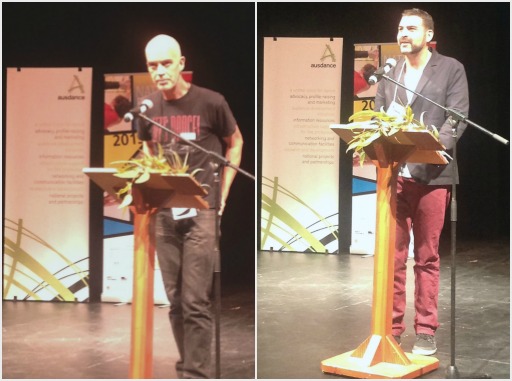 (left) Brian Lucas (National President, Ausdance & independent artist) and Jeff Khan (Co-Director, The Performance Space & Facilitator NDF2013) welcome delegates to the Forum.
Speakers at the forum challenged participants to examine their dance practice, to reach out and engage and to view more broadly who is the ‘dance sector’. Education was a key topic for conversation, with delegates exploring the roll-out of the new arts curriculum, the need for professional development for artists and dance makers, and the opportunities offered by dance education to engage new groups across the community.
 Happy snaps of some of the NDF2013 delegates
Over the coming weeks the input and messages gathered at the forum will be collated with more resources and outcomes being made available here. Five short videos from NDF2013 delegates responding to the issues and themes raised during the forum are ready for viewing now.
NAAE welcomes the new Cultural Policy
The National Advocates for Arts Education (NAAE) welcomes Creative Australia, and particularly its focus on a 'National Arts and Culture Accord' and ‘A Universal Arts Education for Lifelong Learning and to drive Creativity and Innovation’.
National Dance Forum program
Opening and closing with interactive visioning sessions, the program featured a full morning 'Open Space' session on the Sunday tapping the pulse of the forum, and through it that of the dance sector in Australia.
Keynote artists-in-conversation were Dalisa Pigram, co-Artistic Director of Marrugeku, with David Pledger, and Artistic Director of Australian Dance Theatre Garry Stewart with Anne Thompson.
Leap forward for dance education in 2012
The Australian Curriculum: The Arts
This has been an important year in the evolution of the new national dance curriculum.
One of five arts subject with its own body of knowledge, teaching strategies and learning outcomes, dance is soon to take its place in The Australian Curriculum: The Arts.
We have continued to work with the Australian Curriculum, Assessment and Reporting Authority (ACARA) on various drafts of the curriculum throughout 2012, engaging with teachers where the tight timelines for consultation have allowed, and keeping dance educators up to date with regular email bulletins.
The Australian Ballet & dance education
'Out There' is the unique dance education program of The Australian Ballet.
Designed by dance educator Helen Cameron, the program engages with primary schools, students and teachers, led by a team of dancer/educators who have been especially trained by Helen to deliver the program. It's proving that dance in the curriculum not only provides skill development and expressive opportunities, but supports other curriculum areas in the process.
The ABC's 7.30 program recently profiled the 'Out There' program and interviewed Helen about its success.
After a lifetime of research and design of innovative dance curricula for primary schools, Helen was awarded the Australian Dance Award for Services to Dance Education in 2008.
Ausdance honours 80th birthdays of Dr Alan Brissenden & wife Elizabeth
On behalf of the Australian dance community, Ausdance wishes Alan and Elizabeth all the very best on this happy occasion.
Dr Alan Brissenden AM has a long association with Ausdance and a life-long association with the arts. He has been writing dance criticism since his student days in 1950, first in the University of Sydney student paper Honi Soit and then, while still a student in 1952 when he was invited to review for the Sydney Morning Herald. Throughout his long career as Reader in English, specialising in Shakespeare at Adelaide University, Alan has been a regular critic for The Australian, Dance Australia, the Adelaide Review and Radio Adelaide. He was for many years a member of the Board of Governors of the Adelaide Festival and President of the Friends of the State Library of South Australia.
Consultation for draft Arts curriculum about to end
The consultation period for The Australian Curriculum: The Arts has been extended until midnight tonight (25 September), so here's a last opportunity to have your say via ACARA's consultation portal.
Ausdance National has already responded in some detail, thanks to some excellent work by Victorian dance teachers, facilitated by Dr Katrina Rank, Ausdance Victoria's Education & Training Manager.
We also received feedback from individual teachers from around Australia, especially from Queensland, and have incorporated their responses into the Ausdance response.
Teachers have generally been very positive about the draft Dance curriculum, and we hope our detailed response will help to refine it further.
We're looking forward to seeing the final version, so watch this space for further updates.
Good news from major performing arts companies
The latest Australia Council Snapshot of Major Performing Arts Company Key Trends shows that Australia’s major performing arts companies are robust, stable and have continued to expand their city audiences in line with population growth. They have also extended their reach and engagement in regional and remote communities.