

Professional resources
News / Blog / Press Releases / Events
Ausdance submission to the Senate Environment and Communications References Committee
Inquiry into the National Cultural Policy 2025
Late last year Ausdance made a submission on behalf of the national Ausdance network in support of Australia’s dance ecosystem—artists, educators, Cultural dance leaders, companies, studios, festivals, community organisations and allied health partners across metropolitan, regional and remote Australia.
We welcomed the Committee’s targeted interest in (a) tax reform and productivity, and (b) emerging technologies including artificial intelligence (AI).
Our positions are grounded in prior Ausdance submissions (national, state and territory), sector research on valuing the arts, First Nations consultations, and lived experiences of dance professionals, workers, practitioners and small businesses.
The Ausdance national network also applauds and supports ANA’s (A New Approach) “Imagine 2035” call for a National Arts, Culture & Creativity Plan and urges its adoption alongside the National Cultural Policy. Such a plan should include a Strategy-on-a-Page, clear outcomes and measurements, and be underpinned by ongoing collaborations across all levels of government (federal, state, territory, local) and with First Nations leadership.
In recognising culture’s role in addressing major societal challenges we recommend policy settings and funding programs that explicitly allow for arts responses with social / environmental purpose, not only economic outputs.
Read the submission.
Prepared for Australian Dance Council, Ausdance Inc (National)
Email Julie Englefield: Tel. 0426296050
WITH
Australian Dance Council, Ausdance (ACT) Inc
Australian Dance Council, Ausdance (QLD) Inc
Australian Dance Council, Ausdance (SA) Inc
Australian Dance Council, Ausdance (VIC) Inc
Australian Dance Council, Ausdance (WA) Inc
Clarification about status of Award pay rates for dance teachers
Ausdance identifies improved standards in the workplace and increased sector knowledge of employee rights and employer obligations.
Another identified priority is increased professional development/training and support for small businesses and organisations to improve child safety, safer workplaces, safer spaces, safer bodies and minds in the whole dance community.
This article was prepared by Ausdance Qld, and is designed to provide clarification about the status of Award pay rates for dance teachers.
Fair Work Commission
The Fair Work Commission is Australia’s workplace relations tribunal and registered organisations regulator. It makes awards, approves enterprise agreements and helps resolve issues at work.
It has a ‘small business hub’ which specifically answers questions about current issues such as fixed term contracts, ‘right to disconnect’ , family and domestic violence provisions and more.
Employees/ Contractors
The difference between an Employee and a Contractor can be complicated; it is an area of the law that is not set in stone and the definitions used have recently changed.
A contractor is sometimes also called an ‘independent contractor’ or a ‘sub-contractor’, however these terms all have the same meaning. The critical differences between an employee and independent contractor are:
- an employee serves in your business, and performs their work as a representative of your business;
- a contractor provides services to your business and performs work to further their own business.
As a general rule of thumb:
- a person is an Employee if the employer determines where/when the worker (dance teacher) works, and if the employee is required to perform work as a representative of the employer’s business, is paid by the hour or has their pay determined by the employer, and cannot delegate their work to someone else;
- a person is a Contractor if the worker chooses when/where and how the work is done, performs work to further their own business, is generally contracted to achieve a specific result, and is able to subcontract to another person of their choosing.
The awards cover employees and are governed by the Fair Work Commission.
The Dancers Australia Industry Code of Practice covers both employees and contractors, and is governed by the Media, Entertainment and Arts Alliance (MEAA).
All workers must be paid superannuation on top of their fee or wage (i.e. not taken out of their wage), regardless of whether they are an Employee or a Contractor.
The ‘Modern Award System’
The Modern Award System was created in 2009, to provide all Employees in each industry a standard set of minimum wages and conditions. These include:
- common entitlements that included in all awards – eg. a 25% casual loading, a minimum engagement (usually 3 hours), and, from this year, new entitlements, such as the right to change from casual to full time or part time employment, and the ‘right to disconnect’; and,
- specific entitlements that only apply to that industry.
Live Performance Award
The Live Performance Award covers Employers in the live performance industry and their employees who fit within the classifications of the Award.
Regardless of whether the performance, rehearsal, workshop, presentation, or concert takes place in front of an audience or is recorded, the ‘live performance industry’ means:
- producing (pre and post production), staging, lighting, audio and audio/visual, presenting, performing, administrating, programming, workshopping, set and prop manufacturing; or,
- undertaking live theatre, performance art, operatic, orchestral, dance, erotic, variety, revue, comedy, multi-media, choral, or musical performances, productions, presentations, rehearsals, or concerts;
An important feature of this Award is the ‘definition’ of a performance: “Performance means a performance given by Employees before an audience for which the Employer receives a payment or other benefit.”
This Award also includes specific scheduling and rostering clauses, allowances and per diems, rehearsal rates, penalty rates, and other entitlements that are unique to the live performance industry.
Currently dance teachers (employees) are not covered by this award. Choreographers are also not covered by this Award.
Fitness Industry Award
Historically, the dance teaching industry has accepted that dance teacher Employees are covered by the Fitness Industry Award. The current minimum pay rates range from $12.90 for a junior casual teacher to $32.18 and do not provide for specific skills, dance teaching experience or criteria.
Since 2020, dance teacher and studio owner members have regularly informed Ausdance QLD (in consultations) that the rates and associated requirements/provisions are not appropriate for dance teachers. The Union has taken the position that the Fitness Industry Award is not appropriate for dance teachers, and that applying this Award can result in underpayments.
The Media, Entertainment and Arts Alliance (MEAA / the Union)
This is the Union for workers across the media, entertainment, and arts industries, including all dance professionals, actors, musicians, technical crew in theatres, film, and television, journalists, and more.
MEAA was registered on May 18, 1992 as the Media, Entertainment and Arts Alliance, formed from the merger of three unions: the Australian Journalists Association, Actors Equity of Australia, and the Australian Theatrical and Amusement Employees Association. The history of these three unions goes back to the early 1910s, and the current structure of MEAA reflects those origins.
In 2006, a fourth section was created when the Symphony Orchestra Musicians Association joined the Alliance. In 2021, MEAA added another group, Dancers Australia, in recognition of dance-specific workplace issues which impact the working lives, health and careers of dance professionals.
Dancers Australia
Dancers Australia is the union for dancers, dance teachers, and choreographers in Australia. It is led by the Dancers Australia National Committee – a group of dancers, dance teachers, and choreographers from across the country who are pushing for fair wages and safe workplaces for all workers in the dance industry. Dancers Australia is part of MEAA.
The Committee’s first Strategic Plan encompasses four critical components:
- 2022 – undertake research into dancer and choreographer rates;
- 2023 – approve and commence enforcement of an Industry Code of Practice;
- 2024 – undertake research into dance teacher rates; and,
- 2025 – approve a specific Dance Teachers section as an addition to the Code.
Dancers Australia – Dance Industry Code of Practice 2024-2025
This is a voluntary Code of Practice, similar to those in media and advertising. If you are a member of MEAA, or you are a company who is a signatory to the Code of Practice, you are legally bound to comply with this Code.
A new Code is released on 1 July each year, which includes an annual wage increase and any new or updated entitlements.
The Code currently includes rates and workplace conditions for:
- dancers – with the lower range of rates mirroring the Award, and higher range of rates mirroring what is actually paid by reputable companies in the industry; and,
- choreographers – a rate for a choreographer’s time, plus a ‘fee’ for the choreographic product they create.
In 2025, MEAA will add a new Schedule of Dance Teacher Rates. This will include:
- A low tier of rates that need to fit within the rates already in the Award – a minimum of $25.41 per hour, a maximum of $39.69 per hour, for dance teachers with 7 years’ or less experience;
- A high tier of rates that need to reflect what is actually paid in the industry – starting at $40 per hour for dance teachers with more than 7 years’ experience; and,
- A set of workplace conditions – such as penalty rates, overtime, payment for supervising children, allowances/per diems, sick/injury leave, safety protections, etc. – that adequately remunerate for skills and experience, cover the expenses that dance teachers have, match the cost of living, and ensure dance teachers are provided with a safe workplace.
Current situation and next steps
The Fair Work Commission regularly reviews awards as part of the Modern Award Review to ensure they’re fit for purpose and to update rates and conditions. In 2023/4 a targeted review has been undertaken to look at which awards cover workers and the minimum standards in the arts and culture sector.
The final report for the public part of this review was released in July. The Fair Work Commission elected to make minimal changes to the Live Performance Award based on the consensus of ‘interested parties’. Another priority of the Modern Awards Review is to ensure no-one ‘falls through the gaps’ as Employees.
MEAA, led by Dancers Australia, identified to the Commission that choreographers and dance teachers are falling through the gaps in the awards. They have identified this through member consultation and industry surveys. Ausdance QLD and the Ausdance National network have also provided data, and will continue to seek input from our members to inform any changes.
As part of the Modern Award Review process, MEAA proposed that the Live Performance Award be updated to cover these two Employee categories. In the Commission’s report published in July 2024, this change was not adopted. There are no current proposals being considered by the Fair Work Commission.
If there were to be any change to the Award to include dance teachers, MEAA’s current draft proposal is:
- Minimum wages would need to fit within the rates already in the Award – a minimum of $25.41 per hour, a maximum of $39.69 per hour, for dance teachers with 7 years’ or less experience; and,
- Choreographer rates would need to be completely separate, and would not apply to a person who is engaged as a dance teacher (even if that person undertook creating choreography as part of their role).
These proposed changes are substantially similar to what MEAA will be adding to the Code of Practice in 2025.
This draft proposal to the Fair Work Commission is a very long way from being formally submitted, and if submitted would be through the process of lodging a case to the Fair Work Commission, requesting a decision or order, and undergoing tribunal hearings before any decision is made.
Any decisions by the Commission, and information gathered as evidence to support any change, are substantial and rigorous. This is to ensure any changes work for the Australian community as a whole, including small businesses or industry groups.
Return to dance: Principles and framework for restarting dance activities post-Covid-19
In response to huge demand from dance teachers, dancers, independent artists and dance companies across Australia, Ausdance, the peak body for dance, has today released Return To Dance: Principles and framework for restarting dance activities post-Covid-19.
This document provides guidelines for practising dance safely whilst meeting the required health and safety guidelines in a new post-Covid environment. It applies to all members of the dance community: dancers, teachers, studio owners, companies and organisations.
The guidelines directly reference the Framework for Rebooting Sport in a COVID-19 Environment developed by the Australian Institute of Sport. The Ausdance guidelines have received the endorsement of Dr David Hughes, Chief Medical Officer, Australian Institute of Sport Medical Director, Australian Olympic Team, Tokyo 2020.
We recognise that our sector has been decimated by this pandemic, but COVID-19 has also provided an extraordinary opportunity for individuals, companies, small and medium businesses and communities to work together as never before to ensure a safe and productive future as soon as possible.
We also recognise that all dance in Australia sits within the context of 100,000 years of Aboriginal and Torres Strait Islander dance continuum. This is a powerful and extraordinary fact, and protection of First Nations Elders as the source of First Nations storytelling and knowledge in Australia is the first principle of this framework.
Teachers, parents, students, organisers and administrators can use the ‘Return to dance’ document to inform dance practice in classes, rehearsals and performances.
It’s important to remember that these are guidelines for operating within State or Territory directives: they are not an exemption from these directives. If necessary, the Ausdance network may seek exemptions to specific directives supported by ‘Return to dance’, alongside Workplace Health and Safety documentation through the COVID-19 Taskforce.
The Australian dance community has been united in its support for these guidelines which were developed by Ausdance Queensland in collaboration with BlakDance, and with the support of Arts Queensland and the guidance of many vital members of the dance and arts community.
All media enquiries: Julie Englefield, ph 0426296050
Harlequin Floors continues to support the Australian dance community
Ausdance National is pleased to announce the continued support of Harlequin Floors as Principal Sponsor of the Australian Dance Awards (ADAs).
World leaders in advanced flooring technology for dance and the performing arts, Harlequin Floors supports (literally) thousands of Ausdance members on a daily basis.
Fatigue identified as major contributor to injury in Australia’s professional dancers
The Safe Dance Report IV: Investigating injuries in Australia’s professional dancers, published today on the Ausdance National website, examines the Australian context and occurrence of injury in professional dancers and makes recommendations to support sustainable, healthy, and productive dancing careers.
A collaboration between The University of Sydney and Ausdance National, Safe Dance IV is the fourth in a series of Safe Dance research projects. It continues the important work started by Ausdance National almost 30 years ago.
The survey of 195 Australian professional dancers found 97% experienced at least one significant injury in their dance career, compared with 89% in 1999. And 73% of dancers reported experiencing a dance-related injury in the past 12 months.
Author and lead researcher Amy Jo Vassallo, a PhD candidate at the Faculty of Health Sciences at The University of Sydney, said the consequences of these injuries can be quite substantial and include missed performance opportunities and income, ongoing pain and disability, and expensive treatment including surgery. Serious injuries can even lead to early retirement from dance careers and lifelong disability.
‘The proportion of dancers reporting fatigue as a contributing factor to their injury has increased from 26% in 1990 and 33% in 1999 to 48% in 2017’ she said.
‘However, compared with previous Safe Dance survey results, fewer dancers reported poor technique or environment as a contributor to their injury. This demonstrates the benefits of education, policies and interventions regarding safe dancing practice for dancers and teachers at all stages of a dance career, including early teaching and pre-professional training’.
Ausdance National President, Professor Gene Moyle, said the Safe Dance Report IV continues an important lineage for the Australian dance community. Hearing the words “safe dance practice” being so much a part of our language and approach within the dance sector today is a testament to the impact and contribution of the collective Safe Dance reports within our industry.
Recommendations have outlined that access to dance-educated or dance-specialised healthcare services is essential; addressing the cultural aspects of injury reporting is critical; and that a better acknowledgement of the psychological and psychosocial aspects of injury is required.
Key findings
Survey respondents’ employment as a dance performer was most commonly with a dance company (66%) or as an independent dance artist (38%).
Injuries remain common in professional dance, with 73% of professional dancers reporting experiencing an injury in the past 12 months. The most common site of injury was the ankle (26%), followed by the knee (11%) and hip (10%).
The most common injury type was a strain (25%), followed by chronic inflammation (19%) and a sprain (18%).
There was one accidental or traumatic injury for every two overuse or gradual injuries. The most common responses regarding the self-reported contributor to injury were fatigue (48%), followed by new or difficult choreography (39%) and ignoring early warning signs (31%).
Despite 62% of respondents reporting belief that there is still stigma associated with sustaining injuries as a professional dancer, 75% of dancers did say they would seek professional opinion if they suspected an injury. However, only 50% stated they would tell someone within their dance employment and 49% said they would also take their own preventative steps to manage their injury.
Despite seeing a clinician for treatment of their injury, 40% of dancers whose injury was currently unresolved were unsure if their injury would resolve in the foreseeable future. This indicates that many dancers need to be provided with improved and realistic expectations of their injury, capacity to dance during their injury and likely return to full dance ability.
For interview contact:
Amy Vassallo | PhD Candidate
Faculty of Health Sciences
The University of Sydney
Email: [email protected]
Phone: 02 9351 9010 and 02 9351 9108
Ausdance National Council – Ausdance Inc.
Email: [email protected]
Download Safe Dance Report IV media release
National Advocates For Arts Education May 2017 update
by Julie Dyson, Chair
NAAE is coordinating the publication of a new edition of its highly successful More Than Words Can Say – a View of Literacy Through the Arts, last updated in 2003. This has meant re-engaging with the original authors and commissioning a new Foreword. We’re delighted to announce that this will be written by arts educator Professor Robyn Ewing AM of the University of Sydney, author of the influential research paper The Arts and Australian Education: Realising potential.
Ausdance advocacy report
 Ausdance National's new interim National Executive has formally appointed Ausdance National (volunteer) representatives to attend and speak for Ausdance at the following organisations and forums: ArtsPeak, National Advocates for Arts Education, World Dance Alliance and Tertiary Dance Council of Australia.
ArtsPeak update
Ongoing work
As well as recovering from the ArtsPeak National Arts Election Debate six months ago, there has been ongoing work: following up with the Australia Council on the Service Organisations Scan (complete, to be released by the Australia Council in the first quarter of 2017); advocating for the arts courses that will be affected by the VET student loans proposal (ongoing); and continuing to voice the sector’s concerns about the impact of the 2015 budget changes. The Executive has also played a part in Arts Front, and is currently monitoring (with great interest) the new initiative for a Myer, Tim Fairfax Family and Keir Foundations cultural think tank.
Have you done the Safe Dance IV survey?
Ausdance National has a long history of researching dancer health and well-being, and Safe Dance IV is the latest in a series that looks at how professional dancers manage injuries and sustain their careers. Safe Dance IV is a little different to I, II and III, as it is being conducted online by PhD student Amy-Jo Vassalo under the auspices of the University of Sydney.
What do we hope to learn from Safe Dance IV? For starters, the survey will update the authoritative findings from the previous surveys that helped to improve the management of injuries. One of those findings was the importance of the warm-up, especially a warm-up with a cardiovascular component for rehearsals.
And the definition of a professional dancer is probably wider than for the previous surveys as the range and style of professional practice has expanded, so the potentially wider data pool may bring in new information.
In the past few months, information about the survey has been widely circulated through our e-news and on Facebook. Ausdance staff have sent hundreds of emails to dance companies and individual dancers requesting them to share and take the survey. Hard copies have been printed and sent to The Australian Ballet, the West Australian Ballet, and the Queensland Ballet. Don’t be shy about sharing it further!
But we still need more responses to create the size of data pool Safe Dance IV deserves, to allow for the authoritative findings that can help to sustain careers. If you are a professional dancer—and the very first question is a filter question to help answer this—please do the survey. It will take a little time but it is completely worth doing to help sustain your career.
Read more about Safe Dance IV.
Sir Matthew Bourne auditions male dancers for Melbourne production
Arts Centre Melbourne, Matthew Bourne’s New Adventures and Re:Bourne, the charitable arm of New Adventures are working towards a major creative project that will culminate in a one week season at Arts Centre Melbourne’s State Theatre in Autumn 2017.
This project offers an opportunity for Melbourne-based dancers to work for one month with choreographer Sir Matthew Bourne’s leading international dance company.
Sir Matthew Bourne and other members of the New Adventures team will be in Melbourne in August 2016 to audition six male dancers to join the company for this one-off project at Arts Centre Melbourne.
Key information
- Audition date: Saturday 6 August 2016 (applications required)
- Recalls: Sunday 7 August 2016
- Where: Auditions and recalls will be held in a centrally located venue in Melbourne
- Rehearsals & season: Sunday, 14 August 2016 (workshop) & Monday 13 March – Sunday 9 April 2017
- For Melbourne-based male dancers with at least three years of professional level training in classical or contemporary dance with a stage appearance age between 14–22.
- Audition notice and application information on the Arts Centre Melbourne website.
- Applications close COB Tuesday 12 July 2016.
Arts Centre Melbourne seeks two community dance artists for one-off project
Arts Centre Melbourne, Matthew Bourne’s New Adventures and Re:Bourne, the charitable arm of New Adventures are working towards a major creative project that will culminate in a one week season at Arts Centre Melbourne’s State Theatre in Autumn 2017.
This project offers an opportunity for Melbourne-based dance artists and physical performers to work with a leading international dance company.
Sir Matthew Bourne and other members of the New Adventures team will be in Melbourne in August 2016 to find two community dance artists to join the company for this one-off project at Arts Centre Melbourne.
Key information
- For artists with experience in classical or contemporary dance, physical performance, mentoring of young people and dance workshop delivery.
- Interview & workshop date: Monday 8 August 2016
- Training: Friday 12 – Monday 15 August 2016
- Outreach workshops: Monday 3 October – Sunday 11 December 2016 (P/T) & Saturday 18 February and Sunday 19 February 2017
- Rehearsals & season: Monday 13 March – Sunday 9 April 2017 (P/T and F/T)
- Further details and position description on the Arts Centre Melbourne website.
- Applications close COB Tuesday 12 July 2016.
Support Ausdance—the organisation that supports dance
The Australian Dance Council—Ausdance, has for nearly 40 years been at the forefront of inspiring, supporting and informing the dance community in Australia. Working with and for artists, we want to see dance take its place as a premier and integral activity in Australia.
Now we need your support to continue this work. We face a future without ongoing operational funding via the Australia Council for the Arts, putting at risk all that we do.
Dancehouse’s Housemate Residency
The Housemate Residency is about accompanying dance artists through the entire creative process, from vision to realisation. The program offers time to explore, space to examine possibility and the financial support to bring the Resident's project to fruition.
EOI submissions close 7 July 2016 at midnight.
Apply for the Caroline Plummer Fellowship in Community Dance 2017
Apply now for the Caroline Plummer Fellowship in Community Dance. Applications close 1 June 2016.
ArtsPeak calls for restoration of Australia Council Funding
Media Release, 16 May 2016
ArtsPeak, the national confederation of peak arts and cultural organisations, says the Australian arts ecology is under serious threat following the announcement of four-year funding decisions by the Australia Council.
Ausdance National faces challenge
13 May 2016 media release
The Australian Dance Council—Ausdance congratulates the 12 dance organisations which were successful in the four-year funding announcements by the Australia Council. There is a solid core of highly creative, inspiring and highly productive organisations to create and tour dance around Australia and overseas.
Regrettably, the Australian Dance Council—Ausdance Inc (Ausdance National) finds itself amongst the 62 previously funded organisations that have not been successful. Ausdance National has been notified by the Australia Council that it will not receive operational funding beyond 31 December this year. This brings to an end many years of operational support for the work of Ausdance National.
Government turns its back on the opportunity to fix arts funding mess
ArtsPeak—Confederation of Peak National Arts Organisations
Media Release, 4 May 2016 (31KB PDF)
Hopes that the government would take the opportunity to fix the mess it created twelve months ago were dashed, with no mention of arts and culture in the pre-election Budget handed down in Canberra last night.
ArtsPeak spokesperson and Executive Director of the National Association for the Visual Arts, Tamara Winikoff OAM said, “Unfortunately when it comes to the arts, it seems this government is not concerned about forcing job losses and causing chaos, the very opposite of the PM’s mantra about jobs and growth. The 2016 Budget does nothing to redress the devastating impact of the cuts to the Australia Council and ongoing ‘efficiency dividend’ imposed by the government in 2014 and 2015. The cuts total more than $42 million/year. Massive destabilisation of the arts industry is resulting from decisions made by the current government, and without any policy framework, it looks set to continue.”
Ausdance responds to Royal Commission’s public hearing into Centres for the Performing Arts
1 March 2016
Statement regarding hearings by the Royal Commission into Institutional Responses to Child Sexual Abuse
Public hearing into Centres for the Performing Arts
2 March 2016
Ausdance holds the position that any abuse of a child—sexual, physical or emotional—is abhorrent. A dance studio or class is not isolated from the rest of society, no matter how special it may appear or feel. Studio owners and class teachers, like teachers and activity leaders across the whole of our community, have a special responsibility for the welfare of children in their charge. This holds whether it is a small community dance class or a large commercially-oriented studio.
A dance class or studio is first and foremost a business and as such should be subject to regulatory requirements as any business providing recreational services for children. Dance is also a key art form, which in the view of Ausdance makes any abuse of the trust placed by children in their class leaders or studio principals especially serious.
Ausdance notes that the Royal Commission is not enquiring into abuse in dance studios or the entertainment industry. Rather, the Royal Commission is hearing evidence about two specific centres for the performing arts, one of which was for dance. However, Ausdance supports the invitation for anyone who believes they have a direct and substantial interest in the scope and purpose of the public hearing to contact the Royal Commission directly.
Ausdance has a series of guides and fact sheets to assist dance teachers and dance studios. Where relevant, these guides and fact sheets have links to external authorities. The guides include:
- Child safe dance, with links to the Mandatory Reporting Guide, the Australian Institute of Family Studies, and state and territory Child Protection Services and Advice.
- Australian guidelines for teaching dance developed in collaboration with dance studios and dance curriculum organisations
- Code of ethics for dance teachers
- Parents’ code of behaviour
- Professional business practice for studio teachers
- Safe Dance ® practice
- How to choose a dance school for your child
- Work health & safety for the dance industry
- Eating disorders and dancers
Ausdance re-affirms its statement of 15 December 2014 Teaching dance, supporting children.
Download this statement (210 KB PDF)
Neil Roach, A/g CEO Ausdance National
Challenging questions explored at Ausdance dance sector meetings
Ausdance coordinated a meeting of eight representatives of the nationally funded dance companies with the CEO of the Australia Council and senior staff on 12 December 2015.
The aim was multiple: to understand the further implications of the diversion of funds to the National Program for Excellence in the Arts (now Catalyst); to query the status of the vacant role of Chair of Dance, as an announcement had not been made about retaining this role; and to discuss the role of funding in sustaining the dance ecology so carefully developed over the past years.
The diversion of funds does challenge the current number of nationally funded small to medium dance companies, and the announcement of funding or otherwise in April 2016 will reveal the extent of the loss. We note the recent departure of the Australia Council Director Dance Carin Mistry and thank her for many years of dedicated championing of professional dance. We congratulate the new Arts Practice Director, Dance, Adrian Burnett, and look forward to a similarly productive relationship.
Other meetings attended include a teleconference with ArtsPeak; a teleconference convened by the MEAA at the request of freelance commercial dancers to consider minimum pay rates, which will result in a first-ever survey of this sector (think #paythedancers); and a teleconference to consult with youth theatre companies with the thought of learning for youth dance funding.
Single tickets on sale for Arts Learning Forum opening reception and keynote
Opening reception and keynote by Katherine Zeserson (UK)—Single tickets on sale
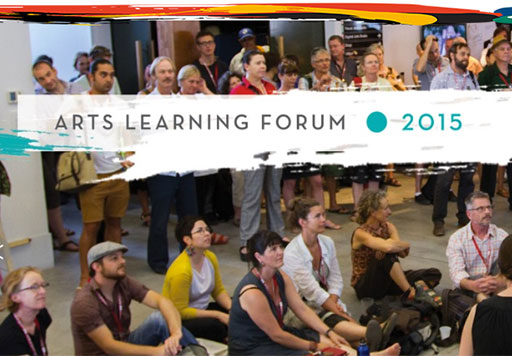
We are releasing extra tickets to the opening reception of the Arts Learning Forum featuring international arts learning champion Katherine Zeserson and followed by a reception by the Maribyrnong River. This opportunity to hear Katherine Zeserson, Uncle Larry Walsh and Tony Grybowski, CEO of the Australia Council is open to anyone interested in arts learning: from tour guides to marketers, educators and CEOs, funding partners and board members. Bring a colleague!
- Time: 3.30 pm registration for 4.00 pm start
- Date: Wednesday 25 November
- Single tickets price for Opening function: $40 available online
The Arts Learning Forum program is a three-day event for arts professionals with a role or interest in arts education, learning or engagement across all art forms, ages and communities. Delegates will exchange insights, practices and creative ideas and be inspired by Australian and international leaders including Katherine Zeserson (UK), Anna Cutler Director of Learning from the Tate in London, and Deborah Cheetham Artistic Director of Short Black Opera Company.