

Second Ocean Dance Festival, 22–24 November 2023
Under the umbrella of the World Dance Alliance–Asia Pacific (WDA–AP), the Second Ocean Dance Festival (ODF) is being organised at Cox’s Bazaar in Southern Bangladesh by Nrityajog, a conglomeration of 40 dance organisations of Bangladesh, from November 22 to 24, 2023.
If you're an Ausdance member there are significant reductions in registration fees [see registration, program and accommodation details above].
Closing date for submissions is 30 July. This year's theme is ‘My dance, my choice’, referring to the artistic freedom to imagine, create and distribute diverse cultural expressions free of censorship, political interference or the pressures of non-state actors.
The second ODF will include the Annual General Meeting of WDA–AP, and will host keynote speeches, academic seminars, workshops, performances and lecture demonstrations by participants from all over the Asia Pacific region.
The festival is envisioned as a showcase of Bangladeshi dance, interspersed by performances from South Asia and the Asia Pacific.
Notice of 2023 Annual General Meeting
Ausdance National
Monday 26 June 2023 at 7pm AEST
The Ausdance National 2023 Annual General Meeting will be held via Zoom on Monday 26 June 2023 at 7pm AEST.
We look forward to welcoming members to the AGM and providing a brief update on the progress of the review currently being undertaken by Ausdance National.
Please RSVP to Jacob Williams by Friday 23 June 2023 to receive the Zoom link if you are able to attend, or if you require a proxy form.
Agenda
1. Acknowledgement to Country
2. Welcome & apologies
3. Tabling of Proxies
4. Minutes of the 2022 AGM (23 June 2022)
5. Matters Arising
- Motion: That the minutes of the AGM held on 23 June 2022 be accepted.
6. Annual Report of activities for 2022
7. Matters Arising
- Motion: That the 2022 Annual Report of activities be accepted.
8. Presentation of 2022 Audit & Financial Report
9. Matters Arising
10. Appointment of Auditors for 2022
- Motion: That the financial report incorporating the 2022 Audit be accepted.
- Motion: That auditors be appointed.
11. Election of current board members to executive
Current members of the Ausdance National Council:
- Acting President: Dr Cathy Adamek (SA/ACT)
- Treasurer: Sebastien Ananian-Cooper (SA)
- Public Officer: Jane Pamenter (ACT)
- Director: Julie Dyson AM (Vic)
- Director: Natalie Allen (WA)
- Director: Isla Gibson (WA/NSW)
- Director: Jacob Williams (NSW)
2023 International Dance Day Message
In 1982 the Dance Committee of the International Theatre Institute founded International Dance Day to be celebrated every year on 29 April, the birthday of Jean-Georges Noverre (1727-1810), choreographer and creator of modern ballet.
Every year a message from an outstanding dance artist is circulated throughout the world. This year's IDD Message is by Chinese dancer and choreographer YANG Liping.

Dance—a way to communicate with the world
Body language is humanity’s most instinctive form of communication. As new-born babies we can use our hands and feet to make dancing-like gestures even before we learn to utter a word, and then dance arises from this 'primitive tongue'.
Many things prompt people to dance. In my hometown, my grandmother once told me that dance is a way to thank the Sun for bringing warmth and light to our lives.
When there is a good harvest, we would dance in the fields with joyous hearts to express our gratitude to the earth. When we meet someone we love, we may dance like a peacock spreading its tail feathers to win their affection. Even when we are sick, we may use mysterious dance rituals to repel the demons of sickness.
In my world, dance has been intricately interwoven into our lives and existence since earliest childhood. It has always been the key that unlocks human beings' communication with nature and all living beings. In my hometown, there is a saying: 'If you have legs but cannot dance, you have wasted your life in vain'.
Dance is closely connected to nature and life. As far as I’m concerned, dance is one and the same with nature and life—that is the true essence of dance.
Some people come to this world to carry on their lineage, some come to enjoy life, some come to seek experiences. For me, I am an observer of life. I come to see how a flower blooms and withers, how clouds float, and how dew condenses.
Therefore, all my creative inspiration comes from nature and life: the brightness of moonlight, the display of peacocks’ plumage, the transformation of a butterfly from a cocoon, the way a dragonfly skims the water’s surface, the way a caterpillar wriggles, the way ants form a queue.
Many years ago on a stage, I faced the audience and danced the first choreography I created—the peacock dance The Soul of a Peacock. Peacocks are still existing animals in the world. It is a creature that symbolises sacrosanctity and represents beauty in the Eastern world because its appearance resembles that of the phoenix, with a reified posture comparable to the dragon. While dancing, I figured out the soul of the peacock.
The dance culture of mankind is bountiful, embracing common culture and attributes. We derive the essence of dance by observing nature, life and all living beings that surround us. My nation, too, has an abundant dance culture that I passionately carry forward as an inheritance. It nourishes the mind and body, giving us the ability to communicate with the world.
I collected some traditional primitive dances and brought them on stage, such as Yunnan Impression, Tibetan Riddle, Pingtan Impression and many more besides.
All these dances originated from the land and were left to us by our ancestors as heritage, which needs our efforts to be preserved and introduced to the world. Once these works were staged, people were deeply impressed by their captivating beauty and cultural significance.
As a dancer, I have continued to explore the boundless realm of dance for decades and have been invited to create experimental contemporary works such as Under Siege—The Full Story of Farewell My Concubine, and Rite of Spring for the global stage.
My art draws its inspiration from nature in my hometown, my personal life experiences, and the profound civilization of the East, which is an integral part of world civilization, as it provides diversity, richness, and above all, inspiration.
'Learning from nature' and 'Unity of man and universe' is the philosophy, the wisdom, and the aesthetics of the East. These doctrines are also the spiritual core of my art. As human beings, we should respect nature, learn from nature, and harmonise with nature, just like the earth, the mountains, and the sky.
Dancers and choreographers need to listen more attentively to the joys and sorrows of the world, using dance to complete the dialogue we have had with nature, and life which has lasted for thousands of years.
Today I will not only continue to share our dance culture with the world, but I also hope to invite all the dancers in the world who love dance and who would like to express their emotions through dance, to jointly dance for conveying our love and praise to heaven and earth.
Life never ends, and dance never stops.
Vale Valda Craig
Valda Craig was a national honorary life member of Ausdance and a leading dance curriculum advocate and teacher during the 1980s and 90s, having taught dance from kindergarten to tertiary level training. As a former National Vice-President of Ausdance, Valda also presented a vision for the future which was always convincing and exciting.
She worked over many years to ensure Ausdance National’s commitment to preserving Australia’s dance history and creating a permanent national archive at the National Library of Australia (NLA).
Her 1988 report, Locate and Access Australian Dance Resources, led directly to the publication of the Ausdance Guide to Australian Dance Companies (Clare Dyson, 1994) and to the employment of the first curator of dance, Dr Michelle Potter, at the National Film & Sound Archive, and later at the NLA.
Valda also worked passionately on the Dancers’ Picnic with founder Keith Bain, and assisted the transition from the much-loved picnic to the Australian Dance Awards in 1997.
Valda was Chair of the Tertiary Dance Council of Australia from 1986 – 93 and was an ambassador for Australian dance education and training as one of the founders of the World Dance Alliance, and as a passionate supporter of the American Dance Festival, where she established scholarships for young Australian artists.
Her special interest in American and European modern dance led her to friendships with such luminaries as Hanya Holm (about whom she wrote her Masters thesis), Martha Hill, Twyla Tharp and Pina Bausch.
Valda was a visiting Fulbright Scholar at the American University in Washington in 1994, and was a public speaker there who introduced Australian dancers, choreographers and companies to new audiences.
Valda’s outgoing personality, sense of humour and optimistic view of what young aspiring teachers could achieve made her an inspirational lecturer of young teachers who often struggled with dance curriculum demands. She made dance experiences possible and enjoyable for hundreds of people.
Valda was made a National Honorary Life Member of Ausdance in 1991 and received an Australian Dance Award for Services to Dance Education in 2011. She died peacefully on 15 January 2023 in Sydney, just prior to her 85th birthday.
The 2022 Federal Budget – responses & resources
The Treasurer Jim Chalmers delivered Labor’s first federal Budget in nine years this week. You can learn more about the specific details of the Budget which are relevant to the artistic, creative and cultural sector by visiting the Office for the Arts website and by reading the media's analyses and responses provided in the links below.
The Ausdance National President commented:
"Further investment in NAISDA in the federal Budget is a positive step in the right direction. It indicates federal Government support for embedding First Nations self-determination and developing workforce capacity within the artistic, creative and cultural sectors.
"This focus, which is fundamental, was one of five key pillars put forward by Ausdance National in its recent submission to the Government's consultation for a new National Cultural Policy. The policy needs to be relevant and have a positive and transformative impact.
"It needs to be understood that dance in Australia sits within the context of a cultural continuum (spanning over 100,000 years) where dance has formed ways of being, knowing and learning for people living in Australia.
"Thanks must therefore be extended to First Nations Peoples for their effective and ongoing custodianship of dance in Australia. Their contributions, cultures and expertise must be acknowledged, embedded and respected.
"To ensure that policy isn't just a vision for the future that stays on paper but can be effectively implemented, further investment will be imperative so that policy can be safely, efficiently and appropriately actioned with positive and transformative effect.
"Whether further investment commitments, relevant to dance, will be made by the federal Government with the announcement of the new National Cultural Policy, remains to be seen."
Media responses
Additional resources
Cultural Policy submissions (Department of Infrastructure, Transport, Regional Development, Communications & the Arts
Although not arts specific, the $10.5 million for a new youth engagement model includes:
- A Commonwealth Office for Youth
- Ongoing funding of the Australian Youth Affairs Coalition
- Youth advisory groups
- A Youth Engagement Strategy.
Live Performance Support Fund (guidelines are yet to be announced)
Code of Practice for Visual Arts, Craft and Design (National Association for the Visual Arts)
This Is How We Do It – the working trends of indie artists and creatives in the performing arts in Australia (Theatre Network Australia)
Be part of our advocacy
Work in, through or with dance? Be a member of your relevant Ausdance network association (National, Qld, Vic, NSW, ACT, WA, SA) and help your future by informing our advocacy work across the network.
Our advocacy helps to inform and influence key stakeholders and is focused on driving cohesive solutions that grow dance sector capacity, and improve creation, delivery and access to safe, diverse and effective dance and dance practices across Australia. We want to see more people living in Australia benefiting from dance activities that improve health, comfort and wellbeing."
Vale Shirley McKechnie AO
We record with great sadness the passing of Professor Shirley McKechnie AO, one of Ausdance’s founders and perhaps the most influential artist and educator in Australia’s recent history.
Shirley’s passion for dance, her unwavering faith in the ability and potential of young artists and educators, and her understanding of the core values of dance, made her one of our greatest and most articulate advocates and mentors. Her life was marked by generosity, intellectual rigour and support for artists across the whole dance spectrum.
Shirley was born in Melbourne in 1926 to a father who had survived service in World War I at the Somme and Passchendaele, and from whom she developed a lifetime interest in science and a passion for the Australian natural environment. Her life in dance was marked by the early influences of Bodenwieser training with artists such as Johanna Kolm (later Exiner), Margaret Lasica and Daisy Purnitzer, and where improvisation and choreography were central.
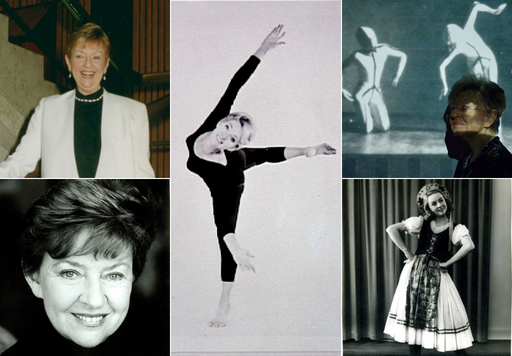 Shirley as a student, professional dancer and choreographer. Top right image of Shirley in On View: Icons (2015) by Sue Healey. The image behind is Twittering Machine from Shirley's Sketches on Themes of Paul Klee (1964).
Her later seminal friendships with artists such as Dame Peggy van Praagh, Keith Bain and Kathryn Lowe, and with the UK's Peter Brinson and the Dean of Education at LaTrobe University, Warren Lett, greatly influenced her later teaching and research.
Shirley’s own career was marked by significant ‘firsts’:
- founder of one of the first contemporary dance schools in Australia in 1955
- founder of one of the earliest contemporary dance touring companies as director, choreographer and performer (Contemporary Dance Theatre of Melbourne 1963-72)
- founder of the first tertiary dance degree course (Rusden State College, 1977)
- a driving force behind the seminal Armidale choreographic seminars (1974–76)
- a founder of the Australian Association for Dance Education (Ausdance, 1977)
- a member of the Council of the Victorian College of the Arts (1974–88)
- assisted with the founding of the first professional dance education company (Tasdance, 1981)
- the founding chairperson of the Tertiary Dance Council of Australia (1985–86)
- interviewer and researcher for the National Library of Australia (1980s–90s)
- guest artist, The Australian Ballet (Nutcracker, 1992)
- National President, Ausdance (1992–94)
- inaugural presenter of the Peggy van Praagh Memorial Addresses (1991)
- founder of Green Mill Dance Project (1993–97)
- patron of the Australian Choreographic Centre (from 1996)
- received the first Australian Research Council grants for choreographic research, Unspoken Knowledges (1999–2001), Conceiving Connections (2002–2005) and Intention and Serendipity: Investigating Improvisation, Symbolism and Memory in Creating Australian Contemporary Dance (2005-2008)
- Professor of Dance at the Victorian College of the Arts (1998) and Honorary Doctorate (2007)
- an Honorary Professorial Fellow at the VCA/University of Melbourne.
As well as being elected an Honorary Fellow of the Australian Academy of the Humanities in 1998, Shirley received numerous awards in recognition of her services to dance in Australia, including:
- an Order of Australia in 1987 (OAM)
- a Kenneth Myer Medallion for the Performing Arts in 1993
- Ausdance 21 Award for outstanding and distinguished service
- two Australian Dance Awards, including Services to Dance Education (1997) and Lifetime Achievement (2001)
- a Centenary Medal (2000)
- made an Officer of the Order of Australia in 2013 (AO).
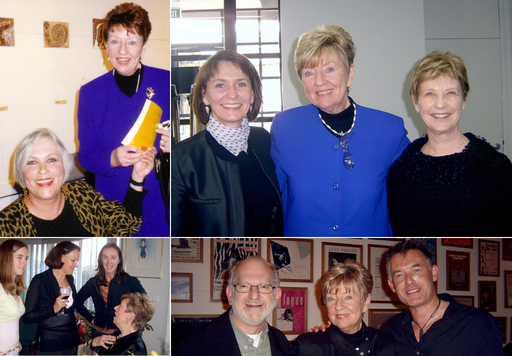 Top left: Shirley at Kathryn Lowe’s book launch in Canberra, 1998. Top right: With Sue Street and Julie Dyson at the VCA in 2006. Bottom left: With Sarah Adams, Jenny Kinder and Sue Healey at Shirley’s 80th birthday, 2006. Bottom right: With Lee Christofis and Mark Gordon at the Australian Choreographic Centre in 2005.
Shirley led several seminal research projects from 1999–2008 that were at the forefront of a new research interdisciplinary area – dance and cognitive science. She had recognised – years ahead of other research groups – that the intellectual, creative and collaborative processes involved in the conception and development of dance works have much to offer psychology, sociology, anthropology, cognitive science and cognitive neuroscience as a lens on human thought, expression, communication, problem solving and decision making.
Shirley and her multidisciplinary team investigated the processes involved in creating new dance works. She analysed and described the choreographer and dancers working together as a ‘community of creative minds’ and as a self-organising system, sometimes centralised and other items distributed.
Shirley crossed disciplinary boundaries and inspired others in the research team to do the same, a catalyst for breakthroughs in thinking across seemingly disparate academic disciplines, leading ultimately to dance connecting with science.
Shirley’s major concern was that audiences for contemporary dance needed to grow, and she therefore applied her research to understanding the ways in which audiences respond to contemporary dance works.
One hallmark of Shirley’s research was the productivity and diversity of output from each project. Sharing practical knowledge from these projects, she also wrote extensively on the value of multidisciplinary research and the challenges and possibilities it entails. Her research writing during the 1980s and 1990s, and her initiating and leading of large interdisciplinary research projects in Australia demonstrated her usual foresight and vision.
Shirley’s pre-eminence in national and international dance research, her leadership in dance scholarship, her ongoing mentorship of young dancers and choreographers and her unprecedented contribution to Australian dance and dance research have created a proud legacy for one of our most revered artists, educators, researchers and mentors.
Ausdance is proud to have been associated so closely with our founder and mentor, and as publisher of much of her research. This is a time to celebrate an extraordinary life, and to reflect on Shirley’s significant achievements.
Author Julie Dyson AM acknowledges the contributions of Professor Kate Stevens, Associate Professor Jenny Kinder and Mark Gordon in compiling this tribute.
Ausdance National 2022 Annual General Meeting
Tuesday 28 June 2022 at 12.30pm AEST
The Ausdance National 2022 Annual General Meeting will be held via Zoom on Tuesday 28 June 2022 at 12:30pm AEST.
The AGM agenda, 2021 SGM minutes and annual report are available below.
Ausdance National's members are dance professionals and cultural leaders from across Australia who engage in a great diversity of dance forms and practices.
With a vision for dance to become a valued part in the lives of all people, Ausdance National's advocacy, programs, resources and partnerships help to facilitate and promote the processes and benefits of best practice dance engagement.
Part of a leading affiliation of peak bodies for dance, arts and culture in Australia, Ausdance National works with the federated network of Ausdance associations – Ausdance ACT, Ausdance NSW, Ausdance Qld, Ausdance SA, Ausdance Victoria and Ausdance WA. Ausdance National is the Australian Chapter of the World Dance Alliance Asia Pacific and is also a founding and continuing member of ArtsPeak, the National Advocates for Arts Education and the Tertiary Dance Council of Australia.
Current Board Members of the Ausdance National Council are:
- President: Lizzie Vilmanis (Qld)
- Vice President: Julie Dyson AM (ACT)
- Treasurer: Sebastien Ananian-Cooper (SA)
- Director and Public Officer: Dr Cathy Adamek (SA/ACT)
- Director: Ella Havelka (Vic/NSW)
- Director: Shyamla Eswaran (NSW)
In 2022 there will be three board vacancies – nominations have previously been called for as per the Constitution.
2022 Agenda Papers
- AGM Meeting Agenda
- Minutes of 2021 SGM
- 2021 Annual Report and 2021 Audit (to be tabled)
To register to attend or to request a proxy form please email President Lizzie Vilmanis.
A zoom link to attend the AGM will be sent after you have registered.
To allow for administration, please RSVP and arrange proxies by Friday 24 June 2022.
Tertiary Dance Council federal election statement
The Tertiary Dance Council of Australia (TDCA) is comprised of academic members from Australian higher educational institutions that offer programs in Dance and Dance Education. It is chaired by Associate Professor Peter Cook, Deputy Head of the School of Education at the University of Southern Queensland.
This national body has identified the absence of a national cultural policy that is inclusive of all art forms, their benefits and accessibility, and the impact of arts education and training on the lives of all Australians.
During the recent pandemic lockdowns, society turned to the arts which pivoted their practice for online audiences, and for aesthetic and well-being contingencies. The arts need to be recognised and celebrated for their capacity to nurture, develop and reinvigorate research for the benefit of the wider society.
The TDCA also has serious concerns about the Federal Government’s re-prioritisation of research funds resulting in ministerial intervention and the enacting of veto powers in relation to the Australia Research Council’s Discovery Grants and Linkage programs.
This narrowing of scope is taking place as we are facing, according to Audrey Azoulay, Director-General of UNESCO, “an unprecedented crisis in the cultural sector” (Reshaping policies for creativity). Although the arts and cultural sector is one of the fastest growing economic sectors in the world, it is also one of the most vulnerable and is often overlooked by public and private investment, including the distribution of public research funds.
Tertiary dance programs undertake practical academic explorations, often involving performance and choreography, that are completely aligned with research principles in their planning, execution and dissemination. They explore contemporary and cultural topics, develop theoretical positions, and engage methods and methodologies that work towards better understanding of, and knowledge about, the issues at hand.
Seeing the downturn of arts-based grants compounds already disenfranchised academics, many of whom are undertaking unfunded and in-kind research projects that benefit society.
Inclusion of arts research projects and their interdisciplinary approaches clearly fits the paradigms from which society benefits. Limiting arts research program funding endangers the unique contribution that arts research makes towards the aesthetic leadership and engagement of well-being, so required as we live through the pandemic world and its recovery.
The technologising of the field, together with its diversification and partnerships across science, health, humanities and ecology, evidences how dance enhances lives across generations and within communities.
We also note the following:
- Covid has had a major Impact on the sustainability of private dance schools, which are TDCA feeder schools.
-
The extreme vulnerability of the arts in higher education.
Recommendations:
- Commitment by all political parties to the development of a National Cultural Policy that includes arts education and training, and developed in consultation with artists, arts educators, the community, industry and peak arts bodies.
- Allocation of ARC grants to a broader industry cohort to redress diminishing arts research in dance in particular. Ministerial interference in ARC decision-making processes must stop.
- Support for research into the vulnerability of the arts in higher education.
- Reversal of increased tertiary fees in the Creative Arts, made on the false premise that this area of study does not lead to employment.
- Enabling of research into the private dance studio sector to assess the impact of Covid-19 on the viability of this important ‘feeder’ sector in dance training and employment.
TDCA members:
Academy of Music and Performing Arts, AC-Arts Adelaide, Australian Ballet School, Australian College of Physical Education, Deakin University, Monash University, NAISDA Dance College, Queensland University of Technology, University of South Australia, Victorian College of the Arts, Western Australian Academy of Performing Arts, University of Southern Queensland, University of Tasmania.
Academy of Music and Performing Arts, AC-Arts Adelaide, Australian Ballet School, Australian College of Physical Education, Deakin University, Monash University, NAISDA Dance College, Queensland University of Technology, University of South Australia, Victorian College of the Arts, Western Australian Academy of Performing Arts, University of Southern Queensland, University of Tasmania.
Ausdance National Board – 2022 call for nominations
Ausdance National calls for nominations to fill several board vacancies on the National Council at the Annual General Meeting.
The AGM will be held via Zoom on Tuesday 28 June 2022 at 12.30pm AEST.
Nominations must be made by email to the National President, Lizzie Vilmanis, by Friday 27 May 2022 via the nomination form, and signed by a nominator and a seconder, each of whom are members of the association. Nominees must be Ausdance members.
General information
In accordance with Ausdance National's Constitution, all National Council roles are volunteer positions.
At present the organisation is not staffed, but the National Council acts as national headquarters and provides leadership on national matters. National Council members are expected to work towards achieving the vision and mission of the association, but there is no obligation for them to carry out duties other than those required by the Associations Incorporation Act 1991 Australian Capital Territory.
Currently, the National Council meets monthly online, and between meetings its board members carry out both governance and operational duties.
Responsibilities of Ausdance National
The National Council is responsible for overseeing:
- The formulation of policies and programs for Ausdance National.
- Effective communication and collaboration with the Ausdance network and the membership.
- National dance advocacy programs on behalf of the dance community.
- The financial management of Ausdance National.
- The sourcing of funds for Ausdance National’s activities.
- The administration of the Ausdance Fund listed on the Register of Cultural Organisations.
National Council membership
The National Council seeks a composition of individual professionals and cultural leaders that is reflective of the diversity of the wider community. The National Council values self-determination of First Nations Peoples and encourages Aboriginal and Torres Strait Islander people to nominate. To service the current mission of the association, candidates who have recognised knowledge, skills, and experience in two or more of the following areas will be highly regarded:
- Dance
- Advocacy
- Health and wellbeing
- Education
- Justice, equity and inclusion
- Accountancy
- Law
- Arts and Cultural Management
- Marketing
- Public relations & communications
- Corporate governance
- Information technology
- Human resources
- Business and systems development
- Strategic planning and change management
- Policy development
- Legislative Processes
Ausdance National is actively committed to helping to build a safer and more inclusive dance sector, and we seek individuals for the National Council who:
- Respect, acknowledge and value First Nations Peoples and Cultures.
- Are committed to advocating for equity, anti-discrimination and intersectional diversity in the Australian dance environment.
- Prioritise and support safe spaces for such discussions.
- Value the unique capacity of dance for cross-cultural exchange, knowledge-sharing, artistic expression, healing and storytelling.
- Will promote and engage in respectful communication, interactions and behaviour across all platforms throughout the dance community.
Nomination process
Along with your nomination form, please outline your skills, knowledge and experience relevant to dance, governance, and/or the skills outlined above.
The following selection criteria will also be considered:
- A commitment to the development of dance in Australia.
- A commitment to serve the mission of Ausdance National.
- Proven ability to think strategically in a changing and dynamic environment.
- High-level skills, knowledge and experience that will significantly contribute to the good governance and future vision of Ausdance National and the Ausdance network.
Based on consideration by the National Council, a shortlist of the candidates who fulfil the board requirements will proceed to member vote at the AGM. Nominees must be members of Ausdance.
Where multiple candidates are recommended by the National Council for a position, these candidates will be selected by election at the AGM.
Appointed positions are for a two-year term.
Contact
Please contact National President Lizzie Vilmanis for further information and to express your interest in nominating.
Australian Dance Awards reviewed
The Board of Ausdance National advises that a review will be conducted to re-evaluate the Australian Dance Awards. This places the current Awards program on hold until the evaluation has been completed.
The review will consider the relevance of the Awards in today’s world, and their impact and value in serving the national dance community and the mission and vision of Ausdance National, including their accessibility, their inclusivity and their viability.
The review forms part of the Board’s appraisal of the association’s positioning and its ability to advocate for cultural leadership and the diversity and professionalism of dance practice, enabling the many benefits dance brings to the lives of people living on the lands now known as Australia.
Ausdance National aims to build awareness, understanding and acknowledgement of the extensive and impactful contributions made by the national dance sector. The roles that cultural leaders, dance professionals – and the pluralism of dance that they facilitate – are essential in shaping quality of life, and must be recognised and valued to be sustainable.
Ausdance National values the shared knowledge, experience and expertise of all of our members. You are vital to shaping Ausdance National activities that are relevant and effective and can support you and serve our mission.
We will be seeking your input about the Australian Dance Awards to inform the review.
Australian Dance Week
The Ausdance network celebrates and promotes dance in all its forms every year during Australian Dance Week (ADW).
The dates for the opening and closing of Australian Dance Week vary slightly from state to state according to local events, but it always takes place during the first week of May and follows International Dance Day which is 29 April. This year's International Dance Day message comes from South Korean dancer Kang, Sue-jin.
Each state and territory Ausdance coordinates a variety of events from book launches and forums to free performances and community classes, and encourages its dance community to promote their own activities throughout the week.
Contact your local Ausdance to see what's happening in your area.
2022 International Dance Day Message
In 1982 the Dance Committee of the International Theatre Institute founded International Dance Day to be celebrated every year on 29 April, the birthday of Jean-Georges Noverre (1727-1810), choreographer and creator of modern ballet. Every year a message from an outstanding dance artist is circulated throughout the world, and this year it marks the beginning of Australian Dance Week to be celebrated throughout Australia.
This year's IDD Message is by South Korean dancer KANG Sue-jin.

The Covid-19 catastrophe has stopped life as we so freely knew it and being amidst this tragedy makes us rethink the meaning of ‘dance’ and ‘dancers’.
In the distant past, dance was a primal means of expression and communication through gestures, becoming performance art that moved the soul and inspired the audience.
It is a momentary art that is difficult to restore to its original form once completed because it’s created with the entire body and soul. Dance is made of ephemeral moments, which destines dancers to be on the move forever. Yet, Covid-19 has restricted and even blocked the art of dance in its original form.
Even though the situation is improving, dance performances are still subject to many restrictions. This makes us cherish the precious memories of times when dance and dancers sparkled like jewels, conveying human anguish and anxiety, will and hope for life, and illuminated the world.
Similarly, it is important to recall that during the aftershocks of the Black Death in Medieval Europe, the ballet Giselle – depicting love beyond death – was performed at the Paris Opera on 28 June 1841 and received an explosive response.
Since then, Giselle has been performed all over Europe and around the world to comfort and encourage the souls of mankind ravaged by the pandemic. It is also my understanding that this was first demonstrated in that very performance of Giselle, as the magnificent spirit of a ballerina trying to escape the gravity of the world’s hardships.
The lonely and weary audience is thirsty for the sympathy and comfort of the dancers. As dancers, we believe that the flapping of our wings gives hope to the hearts of those who love the art of dance and gives them the courage to overcome this pandemic.
My heart is already starting to pound.
Kang Sue-jin
KANG Sue-jin was born on 24 April 1967 and is Artistic Director of Korean National Ballet. She has an honorary doctorate in the Department of Dance, Sookmyung Women's University in Seoul, Republic of Korea. She was Stuttgart Ballet soloist and principal dancer for more than 15 years, and was appointed as Kammertanzerin (Royal Court Dancer), Germany, in 2007. She was Honorary Ambassador of the PyeongChang 2018 Winter Olympics. KANG Sue-jin uses her fame and her artistic skills for introducing children with disabilities to dance. Photo credit: Jail Souen
Tertiary Dance Council responds to political interference in ARC grant programs
The Tertiary Dance Council of Australia (TDCA) is comprised of academic members from Australian higher education institutions that offer programs in Dance and Dance Education. It exists under the auspices of Ausdance National, and is chaired by Associate Professor Peter Cook of the University of Southern Queensland.
The TDCA is seriously concerned about the Federal Government’s re-prioritisation of research funds, resulting in ministerial intervention and the enacting of veto powers in relation to the Australian Research Council’s Discovery Grants and Linkage programs.
The TDCA has recently made a submission to the Senate's Australian Research Council Amendment (Ensuring Research Independence) Bill 2018.
Australian dance educators are also being encouraged to sign the Australian Parliament House Petition to prevent political interference in ARC funding grants (closing on 16 March).
2021 – the Ausdance National year in review
It's been a difficult and challenging year for the Australian dance community, and at Ausdance National we've been very aware of those companies, independent artists and community groups that have suffered so much in some parts of the country. Cancellations, loss of jobs and disruption to practice have created enormous challenges for half the country, with the other half – although protected from Covid-19 – suffering from isolation and disruption of a different kind.
Nevertheless, there have been some inspiring responses to these challenges, which we acknowledge and celebrate.
In June Ausdance National elected a strong and committed working board that has continuedt to deliver on national representation for dance in several ways. It has –
- Reassessed the Australian Dance Awards, with an announcement to be made in January about their future.
- Formed a Diversity and Inclusion task force, chaired by Marilyn Miller, to assist our board with a review of its policies and procedures, and provide support for other dance organisations wishing to take similar action. This will be a major part of our work in 2022.
- Worked closely with ArtsPeak colleagues to develop a pre-Budget submission and key messaging for the Federal election in 2022.
- Re-formed the Tertiary Dance Council of Australia (TDCA), with Prof. Sue Street facilitating 13 institutions that offer dance as a major course of study.
- Completed an analysis of a TDCA questionnaire that reveals the current status of professional dance training, and distributed it to various decision makers including the Arts Minister, the Shadow Arts Minister, the Department of Communications and the Arts, and the Australia Council.
- Worked with our World Dance Alliance colleagues on plans for the next Global Summit in Hong Kong in June 2022, and on the publication of Asia-Pacific Channels and the Journal of Emerging Dance Scholarship (JEDS).
- As with our earlier Safe Dance research, supported the Ausdance network in the development of Child Safe policies and teacher accreditation, both important steps in ensuring the safety and wellbeing of young students.
- Through our dance education subcommittee and the National Advocates for Arts Education (NAAE), provided feedback to ACARA on the new Examples of Knowledge and Skills (EoKS) in the revised Australian Curriculum: The Arts.
- Held regular meetings with State/Territory Ausdances to help harmonise our programs and enhance communication.
Thanks to all Ausdance members Australia-wide for your support – we are really looking forward to planning some serious advocacy for dance in collaboration with our ArtsPeak colleagues in 2022, particularly in the context of a Federal election.
We'd be pleased to receive your donation to assist us to continue this work (it's tax deductible), and we wish everyone a happy new year in 2022.
Towards a safer and more inclusive dance industry
Safety, inclusion and mobilisation at the intersection of diversity requires urgent action.
We believe change is a collective movement and everyone has their part to play in creating the inclusive, accessible and safe dance industry this country deserves.
We also believe that change starts at home, and we are carefully assessing how best to move forward sustainably, respectfully and with appropriate consultation.
The board of Ausdance National:
- Is committed to examining, better understanding and advocating for equity, anti-discrimmination and intersectional diversity in the Australian dance environment.
- Prioritises safety in all its forms and supports safe spaces for such discussions.
- Values the unique capacity of dance for cross-cultural exchange, knowledge-sharing, artistic expression, healing and storytelling.
- Promotes respectful communication, interactions and behaviour across all platforms throughout the dance community.
As a first step towards a safer and more inclusive dance industry, Ausdance National has formed a diversity working party to develop Terms of Reference for a new Standing Committee on Diversity & Inclusion that will advise the Board.
Once formed, we look forward to working with, and supporting, diversity advocates, community leaders, key organisations and industry professionals across the Ausdance network and beyond to enable a more inclusive, accessible and safer dance community for everyone connected by, and living on, these lands.
As a not-for-profit organisation operating without any government funding and a voluntary board, we appreciate your patience in this process.
Ausdance responds to ACARA’s review of the Australian Curriculum
The Ausdance National Education Committee, led by Dr Jeff Meiners and Sue Fox, has prepared a submission to the Australian Curriculum, Assessment and Reporting Authority (ACARA) in response to its review of The Australian Curriculum: The Arts.
The proposed revisions aim to declutter the content through improving the curriculum's clarity of structure and refine the content descriptions and achievement standards. This response relates specifically to Dance in the F-6 curriculum, as this is the identified focus of the review.
As Ausdance’s reps on the National Advocates for Arts Education (NAAE) Council, Jeff and Sue have also contributed to the NAAE's submission, which has reached a review consensus across all art forms.
We thank Jeff and Sue and the Ausdance National Dance Education Committee who contributed to Ausdance's submission, and who will continue to work with ACARA on next steps.
Ausdance National Education Committee members are:
- Rachael Bott (WA)
- Trish Brown (ACT)
- Sarah Calver (NT)
- Peter Cook (NSW)
- Megan Cooper (SA)
- Julie Dyson (ACT)
- Candice Egan (VIC)
- Sue Fox (QLD)
- Lesley Graham (TAS)
- Julie-Anne Grant (QLD)
- Rikki Mace (TAS)
- Kate Maquire-Rosier (NSW)
- Jeff Meiners (SA)
- Helen Mullins (QLD)
- Katrina Rank (VIC)
- Amy Wiseman (WA)
Notice of Special General Meeting
The Ausdance National Executive is calling a Special General Meeting (SGM) for Thursday 12 August 2021 at 7.30pm AEST via Zoom. This meeting will ratify proceedings of the AGM held on 27 June 2021, in the absence of a quorum of directors at that meeting, caused by the late apology of the National President.
Agenda: The purpose of this meeting is to achieve a quorum as per the Constitution in order to –
- ratify the proceedings of the AGM, including the appointment of new directors and changes to the Constitution.
- appoint new Public Officer.
The following motions will be put:
- That the proceedings of the Annual General Meeting of the Australian Dance Council – Ausdance Inc., held via Zoom on 27 June 2021, be ratified.
- That the new Public Officer be formally appointed to the Association
To RSVP, or if you require a proxy form, please email Lizzie Vilmanis. RSVPs and proxies are requested by 11 August 2021 to allow for preparation of the SGM.
Notice of Ausdance National 2021 Annual General Meeting
Sunday 27 June 2021 at 12.30 pm
The Ausdance National 2021 Annual General Meeting will be held via Zoom on Sunday 27 June 2021 at 12.30 pm AEST.
The AGM agenda, 2020 AGM minutes, annual report and revised Constitution are available below.
Ausdance National, the peak organisation supporting dance professionals and the dance ecology at the national level, continues to work with the state and territory network, driving important advocacy to make dance a valued part in the lives of all Australians. This work is especially important in these unprecedented times with the COVID-19 pandemic.
Ausdance National continues to drive support for dance across all sectors and lobby for increased investment.
Elected Board Members at the 2020 AGM:
President: Paul Summers (Vic); Vice President: Julie Dyson AM (ACT); Vice President: Lizzie Vilmanis (Qld); Treasurer: Sebastien Ananian-Cooper (SA); Council Directors: Dr Cathy Adamek (SA), Deborah Robertson (WA), Katy McKeown (Vic); Public Officer: Tamara McKee.
In 2021 there will be four board vacancies – nominations have been called for and received, as per the Constitution.
The Ausdance National Constitution will also be revised and voted on to reflect the organisation's current situation.
2021 Agenda Papers
AGM Meeting agenda
2020 President’s report
Minutes of 2020 AGM
Revised Constitution
Please RSVP to President Paul Summers if you are able to attend, or if you require a proxy form.
2021 Ausdance National board—call for nominations
In accordance with the Constitution, Ausdance National calls for nominations to fill a maximum of three new board vacancies. The Annual General Meeting will be held via Zoom on 27 June 2021 at 12.30 pm.
When nominating, please consider the following:
- Skills & experience—the board needs to include outstanding individuals that have demonstrated skills, experience and knowledge in specific areas and will contribute to good governance and the future development of Ausdance National and dance in Australia
- Diversity—the board should reflect our wider community with an appropriate cultural diversity and gender mix, together with considerations of age. In particular, we encourage applications from First Nations people.
- Location—the board should reflect the breadth of dance activity across Australia. Selection will not be based on location only.
- Board nominees must be Ausdance members.
The following selection criteria will also be considered:
General criteria—all board members
- A commitment to the development of Australian dance
- A commitment to the mission and aims of Ausdance National
- Proven ability to think strategically in a changing and dynamic environment
- High-level skills, knowledge and experience that will significantly contribute to the good governance and future vision of Ausdance National and the Ausdance network.
- A range of networks and contacts.
Additional criteria—President & Vice Presidents
- Demonstrated leadership skills & experience.
- An awareness of funding and arts sector structures and organisations.
- Availability to support Ausdance network communications and policy development.
The board should attract:
- A National Executive of outstanding leaders in the community with extensive networks and contacts. The Executive should include at least one individual who has experience in a senior role within the professional dance sector.
- Senior dance artists, arts managers and producers
- A qualified CPA or Chartered Accountant
- Law professionals
- Marketing, public relations and communications experts
- Senior staff from the tertiary and/or education sector
- Senior corporate and/or government (non-arts) representatives
- Experts from areas including technology, human resources, business development.
Nominations must be received on the nomination form by Monday 31 May 2021. Please contact National President Paul Summers for further information and for the nomination form.
International Dance Day Message 2021
In 1982 the Dance Committee of the International Theatre Institute founded International Dance Day to be celebrated every year on 29 April, the birthday of Jean-Georges Noverre (1727-1810), choreographer and creator of modern ballet. Every year a message from an outstanding dance artist is circulated throughout the world, and this year it marks the beginning of Australian Dance Week to be celebrated throughout Australia.
This year's IDD Message is by German dancer Friedemann VOGEL.
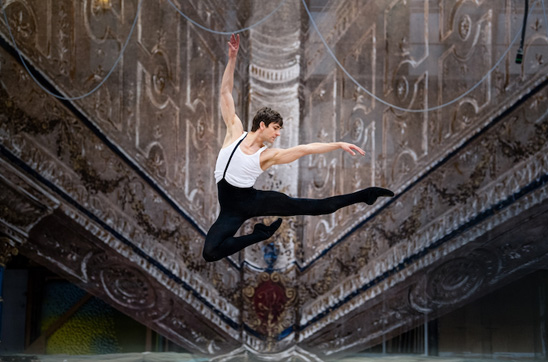
Everything starts with movement – an instinct we all have – and dance is movement refined to communicate. Much as flawless technique is important and impressive, it is ultimately what the dancer expresses inside the movement that is the essence.
As dancers, we are constantly on the move, aspiring to create these unforgettable moments. Regardless of the dance genre, it’s what every dancer strives to achieve. So, when all of a sudden, we aren’t allowed to perform anymore, with theatres closed and festivals cancelled, our worlds come to a standstill. No physical contact. No shows. No audiences. Never in recent history has the dance community been so collectively challenged to stay motivated, to find our raison d’être.
Yet, it is precisely when something precious has been taken away from us that we truly appreciate how vital it is what we do, and how much dance means to society at large.
Dancers are often celebrated for their physical prowess, when in fact we are sustained even more by our mental strength. I believe it is this unique combination of physical and psychological agility that will help us overcome, to reinvent ourselves to keep dancing, and to keep inspiring.